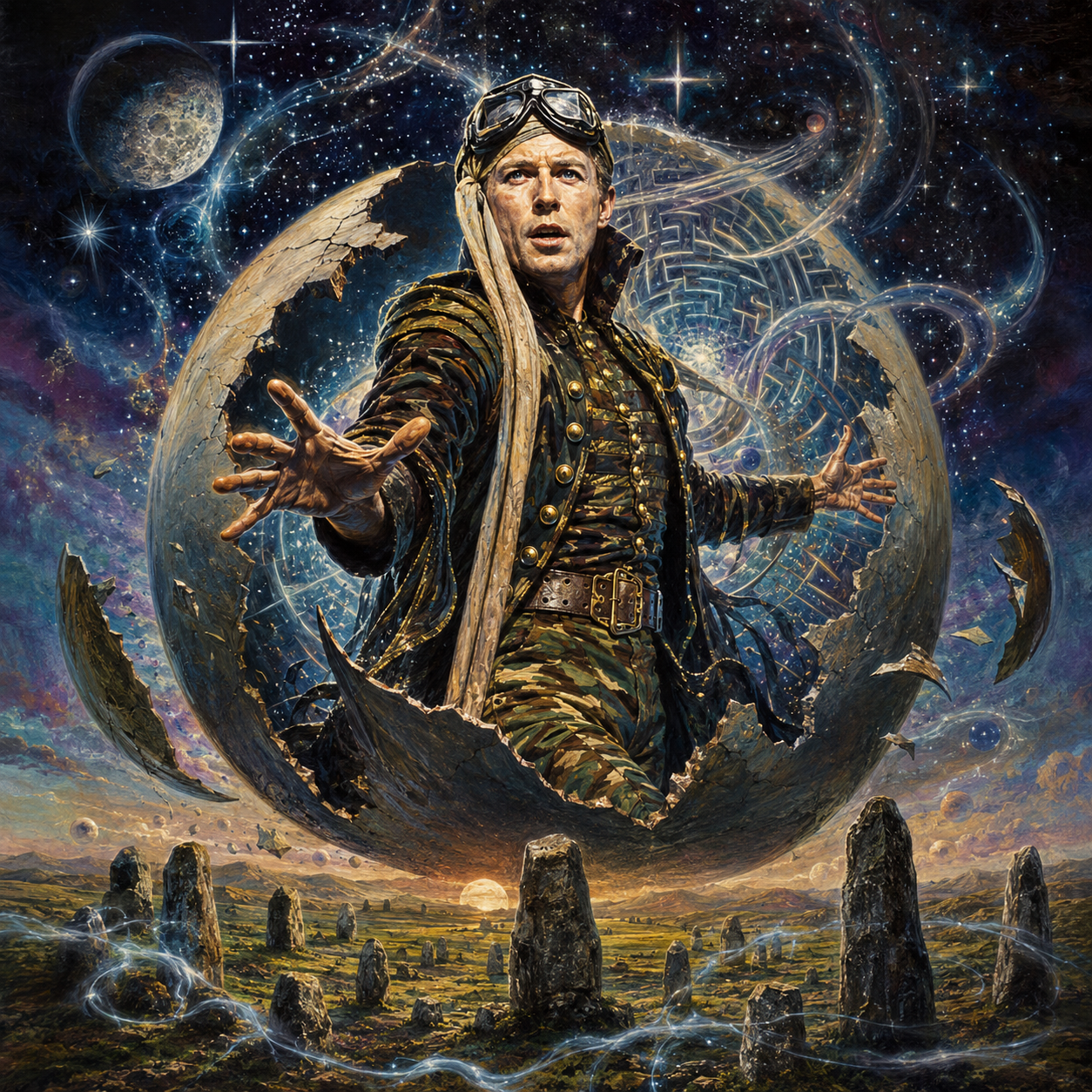
Rebort Calvert – Mystic Hero
Born to Go: The First Heroic Surge Beyond the Ego-Shell
If “Welcome to the Future”, from Hawkwind’s signature live album, Space Ritual shows the world humanity has made, and “Seven By Seven” later shows the soul searching for the astral doorway, then “Born to Go” belongs much earlier in the initiatory sequence. It is not yet wisdom. It is not yet mastery. It is not yet even full knowledge of the task. It is the first surge of recognition: the sudden, elated, dangerous feeling that one cannot remain inside the old container.
We are on that runway, but for the very first time!
The song feels both joyous, yet determined because it seems to be sung as if from the moment before the descent has fully begun. The traveller has not yet passed through the dark night. They have not yet explored the shadow. They have not yet reached the void. They have not yet discovered the strange burden of the role. But something has already awakened. Something inside the shell has begun to push outward.
This is why the repeated declaration that we were “born to go” is so important. It does not merely mean travel, speed, adventure, or science-fiction flight. It suggests a developmental necessity. The human being is not born to remain fixed inside the inherited ego-structure. The self is not born to stay sealed inside the capsule, the mask, the labelled can, or the social identity assigned to it. Something in the person must move, grow, learn, break out, and enter the unknown.
Please accept YouTube cookies to play this video. By accepting you will be accessing content from YouTube, a service provided by an external third party.
If you accept this notice, your choice will be saved and the page will refresh.
At this stage, however, the traveller does not yet know what this means. They may feel chosen, but they do not yet understand the cost of that choice. They may sense a mission, but they do not yet know its form. They may feel the shadow at the edge of awareness, but they have not yet explored it. They may glimpse that the inner world and outer world are connected, but they have not yet understood how deeply the inner dream becomes the outer reality.
So the “chosen one” idea has to be handled carefully. This is not necessarily a claim of superiority over others. It is more intimate and more dangerous than that. The person has chosen themselves to become their own hero.
They have accepted, perhaps only instinctively, that nobody else can do this work for them. No institution, diagnosis, family, priest, teacher, ideology, consumer identity, or social role can complete the journey on their behalf.
The hero is not chosen because they are special in a flattering sense. The hero is chosen because they have stopped being able to remain asleep.
That gives the song its elation. The music does not sound like a cautious philosophical proposition. It sounds like launch, ignition, birth, acceleration. It evokes the joy that comes when the self first realises that the unknown is not only terrifying; it is also alive. The abyss is frightening, but it is also calling. The unexplored self is not merely a region of danger. It is a field of possibility.
This is the joy before the first full crash into the none-existence of self!
The ego-shell has begun to crack, and the first sensation is freedom. The person may not yet understand that the shell was also protection. They may not yet know that breaking it will expose them to uncertainty, grief, hidden sorrow, the void, and the collapse of comforting ideas. But in this early moment, the cracking of the shell feels like liberation. The person feels the thrill of movement before they feel the terror of depth.
The Anima Mundi, the soul of the Earth, is calling!!
This is why the shell is such a powerful image. At first, it is the egg: the structure in which the self forms. Later, after awakening, it may be seen as the capsule: the containment system that keeps the sleeper inside a controlled dream. Later still, it may resemble the labelled can: the packaging that claims to define the living contents. But in “Born to Go,” the shell is still at the moment of breaking. It is not yet fully understood as prison, mask, capsule, or system. It is simply the thing that can no longer contain what is growing inside it.
The song therefore gives us the first heroic proposition:
I was born to go.
I was born to become my own hero.
I was born to move beyond my ego.
I was born to enter the show consciously, not merely be carried by it.
The “show” matters because the album’s science-fiction frame can be read as an imaginal theatre. Space is not only outer space. It is inner space. The journey outward is also a journey inward. The stars are psychic lights. The maze is both social and internal. The abyss is both cosmic and personal. The dream is both private imagination and collective reality.
And that inner-space, it can be so very deep!
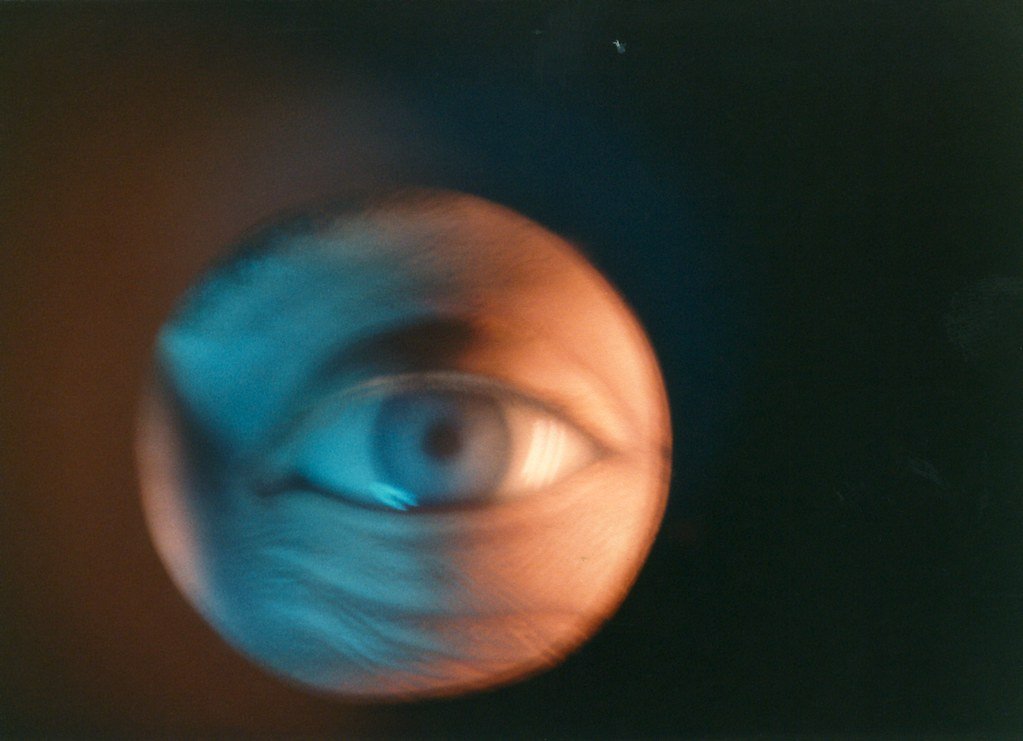
“The Eye from the Adventure Through Inner Space — Mighty Microscope” by ATIS547 is licensed under CC BY-NC-SA 2.0
This means that when the song speaks of blazing a path through space, that space may be understood as the open field of the psyche. The traveller is not merely flying through galaxies. They are entering the inner universe that later songs will reveal as dark, deep, lunar, symbolic, sorrowful, and potentially void-like. They are going into the unknown self.
The line about hatching dreams into reality adds the crucial metaphysical dimension. The dream is not just an illusion to be dismissed. It is a formative power. What is imagined inwardly can become enacted outwardly. Human beings hatch dreams into systems, technologies, identities, communities, rituals, wars, markets, religions, diagnoses, labels, and futures. The dream can become liberation, but it can also become the prison.
This insight links “Born to Go” to “Welcome to the Future.” The later dystopian world of dehydrated lands, self-policing, and labelled containment may be the result of dreams hatched unconsciously. Humanity dreams through fear, control, shame, appetite, domination, and denial; then it builds those dreams into the world and forgets that it helped create them.
So “Born to Go” contains both promise and warning.
The promise is that the dream can be hatched consciously.
The warning is that every dream we hatch becomes a reality we must inhabit.
This is why the journey must pass through self-exploration. If the dreamer does not know themselves, they will hatch their shadow. If the person does not know their fear, they will build a fearful world. If they do not know their shame, they will build systems of blame. If they do not know their desire for control, they will build surveillance and call it safety. If they do not know their wound, they will turn others into the problem.
At the beginning, the hero does not yet know this. They only know that they must go. They see the shadow, but have not yet entered it. They feel the call, but have not yet understood the burden. They sense that the old world is too small, but have not yet discovered that the outer maze is partly made from the inner maze.
That is why this song should be read before “Down Through the Night.” “Born to Go” is the ecstatic consent to the journey. “Down Through the Night” is what happens once the journey begins to strip away certainty. The first song says: I must break free. The next says: breaking free means falling through the dark.
The heroic surge is therefore real, but incomplete. It is necessary, but not sufficient. Without it, the person never leaves the shell. But if they mistake the surge itself for final knowledge, they may become inflated. They may think that wanting freedom is the same as understanding freedom. They may think that seeing the shadow from a distance is the same as integrating it. They may think that feeling chosen is the same as knowing the role.
The joy is genuine. The music knows the exhilaration of the first opening. It knows the feeling of movement after long confinement. It knows the brightness of anticipated discovery. It knows the thrill of realising that the self is larger than the ego-shell.
But the song’s joy is also pre-ordeal. It is the joy of setting out before the night has fully descended. It is the joy of the hero before the abyss has removed every comforting certainty. It is the joy of the dreamer before discovering that dreams become worlds, and that some worlds become traps.
“Born to Go” is not the end of the path. It is the first vow. It says that the human being was not born to remain sealed inside the ego-egg. It says that the maze holding the human race is not final. It says that inner space must be explored, even if that exploration leads through darkness, sorrow, void, and the collapse of inherited meaning. It says that the self must become active in its own becoming.
The traveller does not yet know the full map. They do not yet know the cost. They do not yet know what waits beyond the shell. They only know that staying asleep is no longer possible.
And perhaps that is the beginning of the whole ritual: not mastery, not certainty, not enlightenment, but the brave and joyous decision to go.
To become one’s own hero.
To enter the unknown self.
To move beyond the ego.
To discover what dream is being hatched.
And to accept that once the shell breaks, there may be no honest way back.



0 Comments